
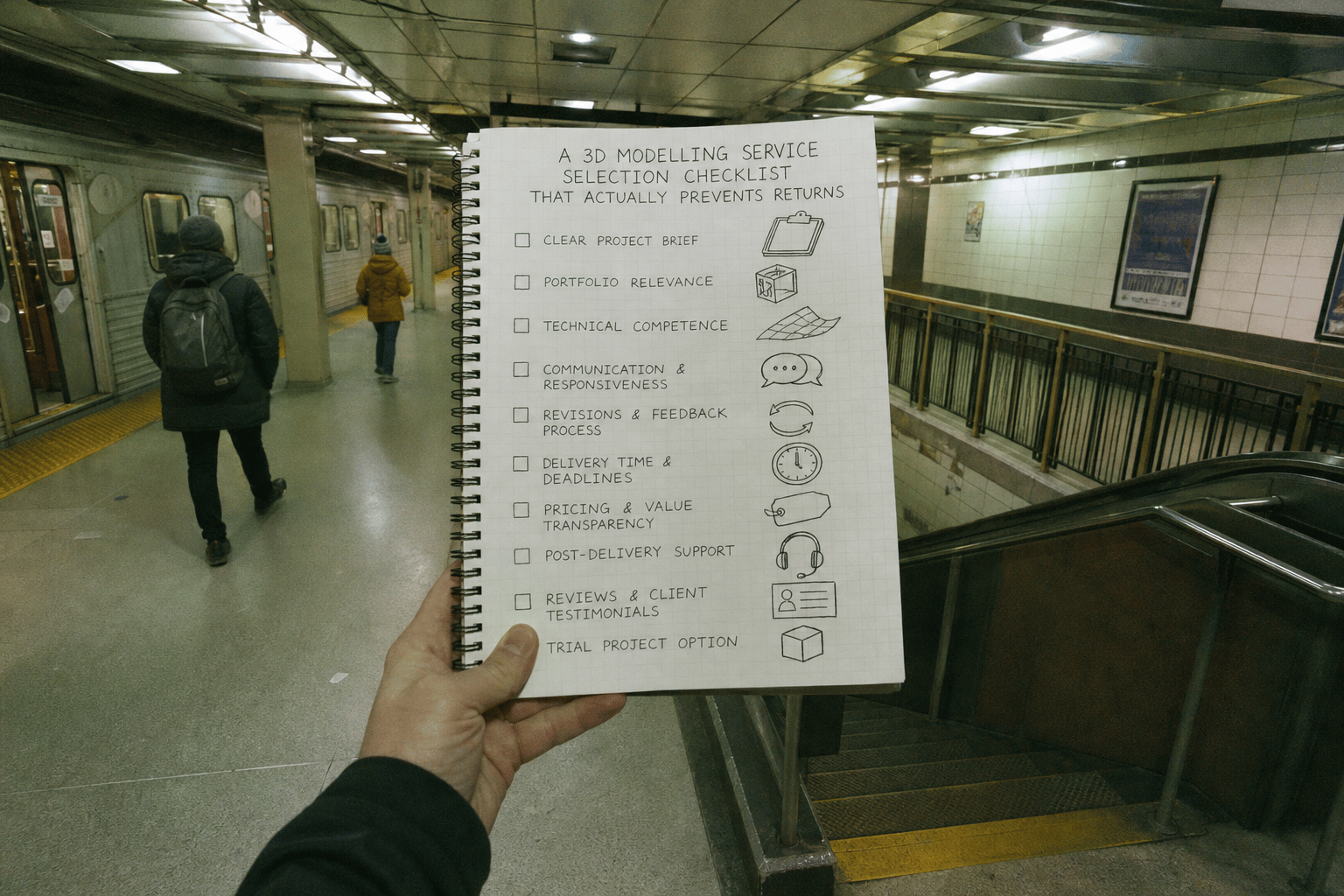
A 3D Modelling Service Selection Checklist That Actually Prevents Returns
Are you choosing a 3D modelling service the way you'd choose a stock photographer, or the way you'd choose a business partner?
That's the question a furniture brand manager should be asking when three quotes land on the desk. Two vendors promise a two-week turnaround and a price that makes the decision easy. The third costs more, takes longer to even send a proposal, and spends the first call asking questions: How do customers browse your catalog today? Which SKUs get returned most, and why? Do shoppers configure finishes before they buy, or after? It's tempting to see those questions as friction. Most brand managers pick one of the cheaper two. Six months later, the models look fine in isolation and do almost nothing for the return rate they were supposed to fix.
The problem isn't the rendering quality. It's that price and turnaround are the only variables being compared, when neither one predicts whether a customer will trust what they see enough to skip the return. Here's a checklist built around the variable that actually matters.
Step 1: Define Your Real Problem (Not Your Feature List)
Before requesting a single quote, write down the actual business problem in one sentence. Not "we need 3D models" — that's a feature, not a problem. Is the goal fewer returns on upholstered pieces where fabric texture gets misjudged online? Higher add-to-cart rates on a configurable kitchen line? Fewer support tickets asking "will this actually fit my space"?
Each of these points to a different service capability. A vendor optimized for marketing-hero renders may be the wrong choice if your real issue is customers misjudging scale and returning oversized sectionals. A vendor built for configurators is overkill if your catalog is mostly static accent pieces. Write the problem down first, then let it filter which capabilities are non-negotiable and which are nice-to-haves. Skip this step and you'll end up evaluating vendors on their portfolio's visual polish, which tells you almost nothing about whether they'll solve your specific problem.
Step 2: Assess Model Complexity and Your Product Range
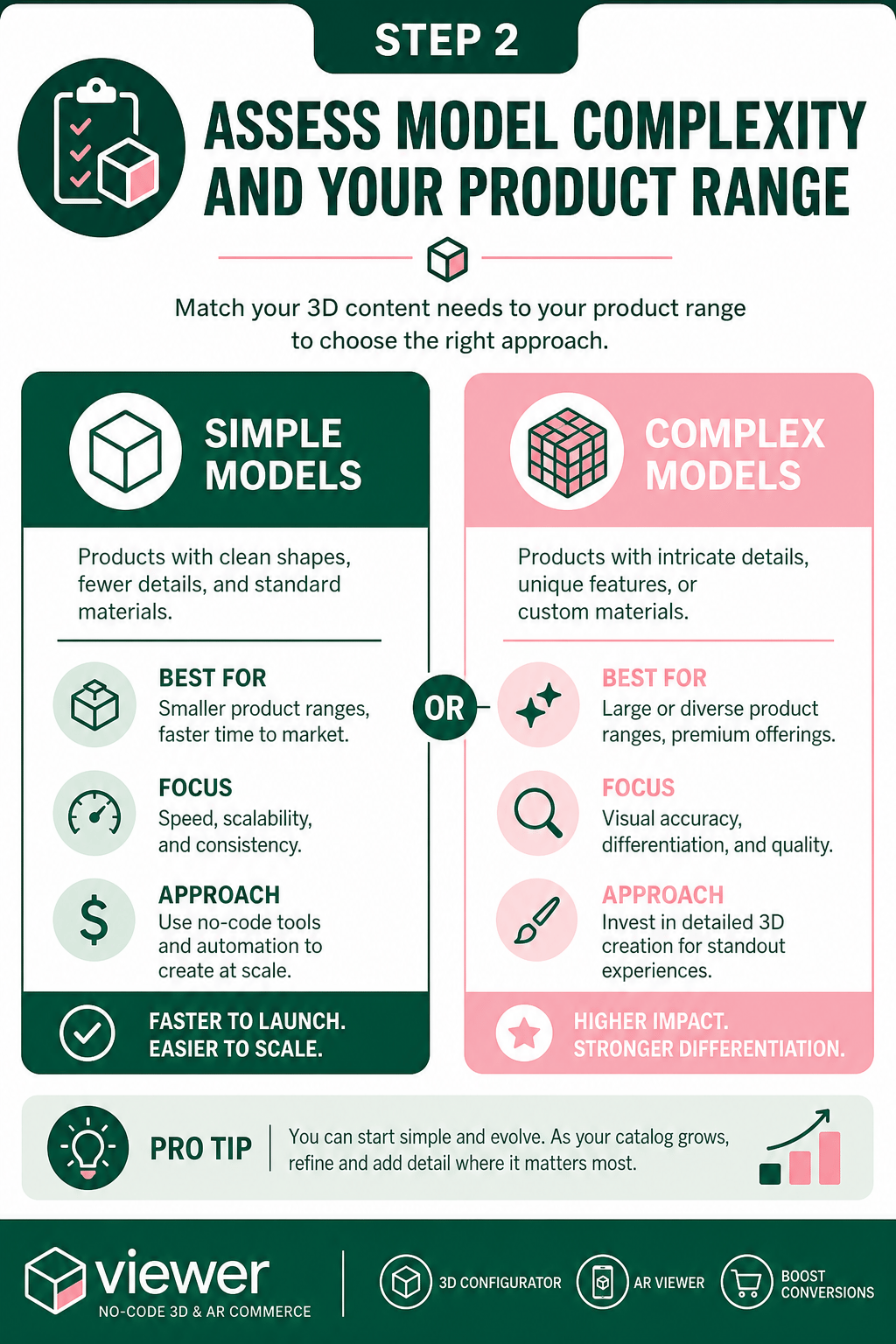
Not all furniture catalogs are equal, and not all 3D modelling services are built for the same complexity. A static accent chair in one finish is a different job than a modular sofa with twelve fabric options, three leg finishes, and configurable chaise orientation.
Ask candidates directly: how do you handle configurable products versus one-off static pieces? What's your process for matching material properties like weave texture, leather grain, or wood finish variation — not just color? Can they show examples across your actual product range, not just their best-case hero shots?
Equally important: do you have the internal expertise to brief them correctly? If your team can't articulate material specs, scale tolerances, or which SKUs are configurable versus fixed, even a strong vendor will produce models that look right and behave wrong. The best vendors will ask about this gap upfront and help close it. The cheaper ones usually won't ask at all — they'll just build to whatever brief you hand them, errors included.
Step 3: Check Compatibility With Your Commerce Stack
A beautifully rendered 3D model that doesn't load cleanly on your product page is a liability, not an asset. Before signing anything, confirm the vendor has real, specific experience with your platform — Shopify, a custom-built storefront, a headless commerce setup — not a general claim that "our files work everywhere."
Ask for load-time benchmarks on mobile, not desktop demos. Ask how they handle file formats and compression for your specific CMS. Ask what happens when your platform updates its theme or checkout flow — does the integration break, and who fixes it?
This is where the cheaper, faster vendors tend to fall short. They optimize for rendering quality because that's what's visible in a sales pitch. They don't always optimize for how that render performs inside your actual tech stack, under real mobile network conditions, for a customer who's three seconds from abandoning the page. A platform built for no-code 3D and AR commerce, like Thridify, treats stack compatibility as a day-one requirement rather than a post-launch fix — because a model that's technically excellent but slow to load solves nothing.
Step 4: Verify Their Understanding of Customer Behavior
This is the step most price-focused evaluations skip entirely, and it's the one that separates a vendor who delivers files from one who improves outcomes.
Does the vendor ask how customers will actually use these models? Will they be rotated in a static gallery, dropped into an AR view in someone's living room, or manipulated inside a configurator where a customer swaps fabric and leg finish in real time? Each use case demands different polygon counts, texture resolution, and file structuring. A model built only for a desktop gallery view often performs poorly in AR, where lighting and scale accuracy matter far more.
The right vendor will ask about your customer journey before quoting a format. They'll want to know whether shoppers are comparison-browsing on mobile, finalizing a big purchase on desktop, or standing in a store checking fit against their own wall. This matters because the underlying reason brands adopt 3D and AR in the first place is to give customers the confidence that comes from seeing — and placing — a product accurately before they commit. A vendor who never asks about this is building assets, not solving the problem you defined in Step 1.
Step 5: Validate Scalability and Support Structure
A quote covers today's catalog. It rarely covers what happens when you add forty new SKUs next quarter, or need twelve revision cycles because a supplier changed a fabric swatch. Ask candidates directly how they price and turn around revisions — not just initial builds. Ask what happens if you need to scale from 50 to 500 models in a year. Ask who you'll actually talk to when something breaks, and how fast.
This is also where strategic partnership shows up concretely, not just as a sales phrase. The vendors worth paying more for are the ones who treat post-launch support the way retail teams treat customer relationships — following up, referencing past context, catching issues before they become patterns. In-store, that kind of attentiveness is what makes customers feel remembered rather than processed. A 3D modelling partner should operate the same way: proactive, specific, invested in your outcomes past the invoice date, not just fast to deliver and quiet afterward.
Price and turnaround are easy to compare on a spreadsheet. Whether a vendor understands your product complexity and your customers' actual behavior is harder to assess in a single quote — but it's the variable that determines whether your return rate actually moves.
Download our 3D modelling service comparison template and start your vendor evaluation with the right questions.
Have questions or ready to get started?
Get in touch with Thridify