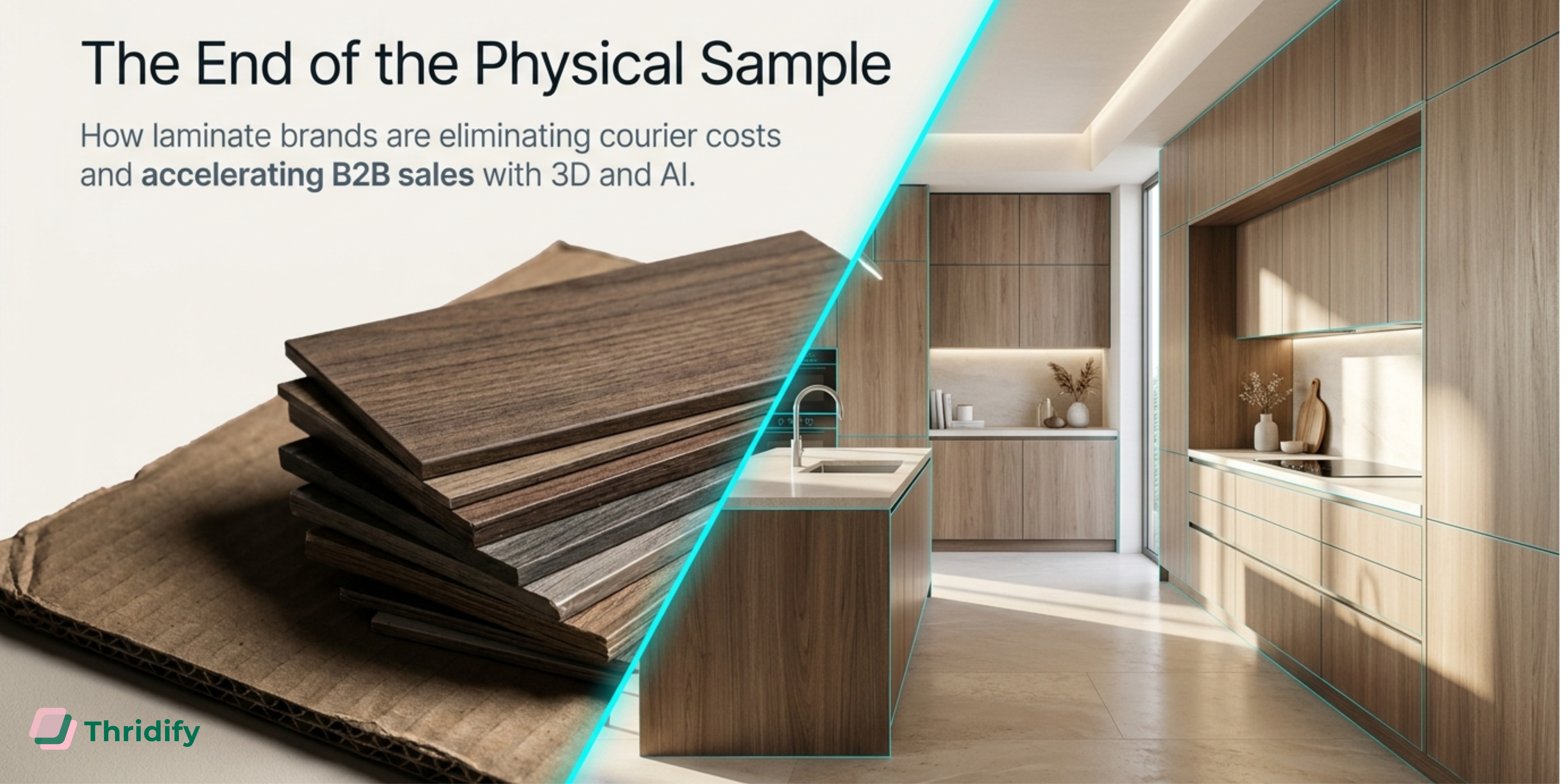

In the competitive landscape of the wooden laminate industry, manufacturers and retailers have long relied on a singular, time-tested tool: the physical swatch book. For decades, these hefty binders filled with small rectangular samples were the gold standard for sales. However, as the industry evolves and consumer expectations shift toward digital-first experiences, the limitations of these physical tools are becoming a bottleneck for growth.
Today, the industry is facing what experts call the “Paradox of Choice.” While customers appreciate having a vast array of textures, grains, and finishes to choose from, they are often paralyzed by the sheer volume of options because they lack the necessary context to make a confident decision. This is where the next generation of sales tools—specifically Thridify-powered 3D enabled catalogs—is outperforming traditional methods by providing the “context” that physical samples simply cannot offer.
The Problem with the Status Quo: Why Physical Swatches Fall Short
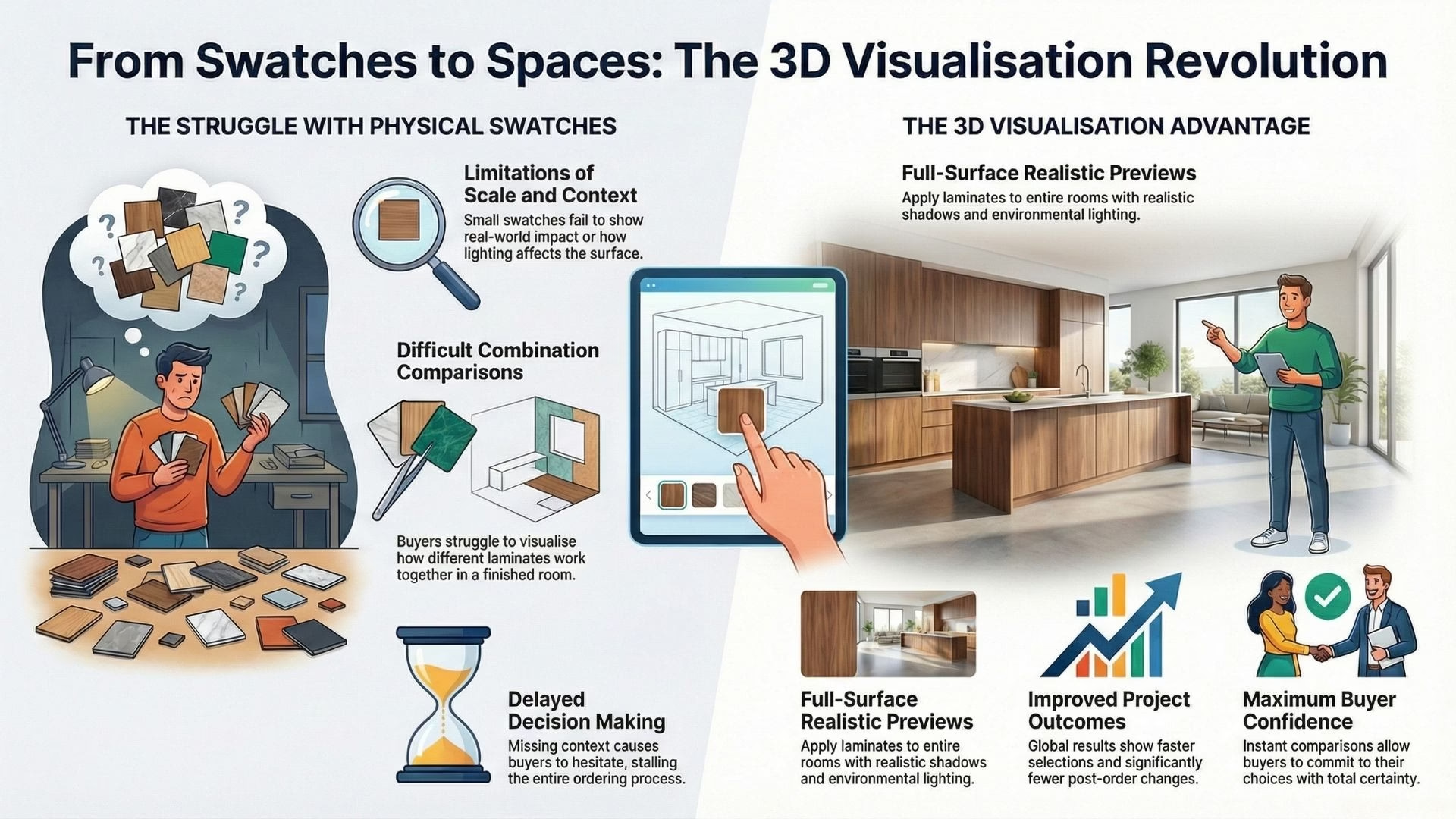
For a customer designing a kitchen or an office space, a 4-inch laminate swatch is supposed to represent a 10-foot surface. This massive gap in scale creates several friction points in the sales cycle:
- Too Small to Judge Real Impact: It is nearly impossible for the human eye to accurately project how a tiny pattern will look when repeated across a large wardrobe or a conference table. A grain that looks subtle on a swatch might look overwhelming on a full wall.
- Lack of Environmental Context: Physical swatches are usually viewed under the harsh fluorescent lights of a showroom or in the trunk of a designer’s car. They offer no insight into how the material will behave under realistic lighting and shadows found in a home or office environment.
- The Difficulty of Comparison: Comparing three different oak finishes by flipping through a physical binder is cumbersome. It makes it difficult for buyers to visualize combinations, such as how a specific wood grain interacts with a solid-colour laminate.
These limitations lead to “buyer’s remorse” or, even worse, decision paralysis, where the customer delays the order indefinitely because they aren’t sure they’ve made the right choice.
The 3D Revolution: How Thridify Reinvents the Catalog
A Thridify-powered 3D enabled catalog doesn’t just show a product; it simulates an environment. By moving beyond static images and physical scraps of wood, 3D visualization solves the most significant pain points of the laminate buyer’s journey.
1. Full-Surface Application
The most immediate advantage of a 3D catalog is the ability to see full-surface application. Instead of guessing, a customer can see a specific laminate applied to a 3D model of a kitchen cabinet, a door, or a wall panel. This eliminates the guesswork associated with pattern repeats and scale, allowing the buyer to see the “big picture” before a single sheet is cut.
2. Realistic Lighting and Shadows
Materiality in the laminate industry is all about how light hits the surface. Whether it is a high-gloss finish, a deep-textured matte, or a metallic sheen, realistic lighting and shadows are essential for a realistic preview. Thridify’s 3D engines simulate how different light sources—natural sunlight from a window versus warm indoor lighting—interact with the texture of the laminate. This level of detail builds a bridge of trust between the product and the consumer.
3. Instant Comparisons and Combinations
In a digital 3D environment, instant comparisons become a reality. A designer or homeowner can swap out finishes with a single click. They can test a dark walnut against a light ash in seconds, seeing the results side-by-side in a rendered room. This capability turns a stressful decision-making process into an interactive and even enjoyable experience.
Global Impact: Proven Outcomes
The shift toward 3D visualization is not just a theoretical improvement; it is a proven business strategy with measurable outcomes. Across key markets including India, the Middle East, the US, and Canada, companies implementing 3D enabled catalogs have reported significant improvements in their sales funnels.
- Faster Selections: When customers can see exactly how a product looks in a finished room, the time spent “mulling it over” drops drastically. 3D visualization provides the clarity needed to say “yes” faster.
- Fewer Post-Order Changes: One of the biggest headaches for laminate manufacturers is the “change order”—when a customer receives their order and realizes it’s not what they imagined. 3D catalogs significantly reduce these occurrences because the buyer’s expectations are aligned with reality from the start.
- Higher Buyer Confidence: Confidence is the currency of the modern economy. A customer who can “walk through” a virtual room featuring their chosen laminates feels empowered and certain in their investment.
The Psychology of Choice
It is a common misconception that the way to help customers is to simplify the product line. However, the sources suggest a different reality: Customers don’t need fewer laminates; they need better ways to see them.
In the wooden laminate industry, variety is a strength, not a weakness. The problem only arises when that variety becomes a “wall of noise.” Thridify-powered catalogs act as a filter for that noise, organizing vast inventories into a visual language that customers can understand. By providing context, 3D tools transform a catalog from a list of products into a gallery of possibilities.
Conclusion: Embracing the Digital Shift
As we look toward the future of the wooden laminate industry, the companies that will thrive are those that recognize the limitations of the physical world. While physical samples will always have a place for tactile verification, they can no longer carry the weight of the entire sales process.
Thridify-powered 3D enabled catalogs offer a competitive edge that is impossible to ignore. They reduce the friction of the “paradox of choice,” provide the realistic context of lighting and scale, and ultimately lead to faster, more confident purchasing decisions.
For manufacturers and retailers, the message is clear: To outperform the competition, stop asking your customers to use their imagination. Start giving them the 3D tools to see the finished result for themselves. In the end, better visualization isn’t just a tech upgrade—it’s the key to unlocking the full potential of your product range.