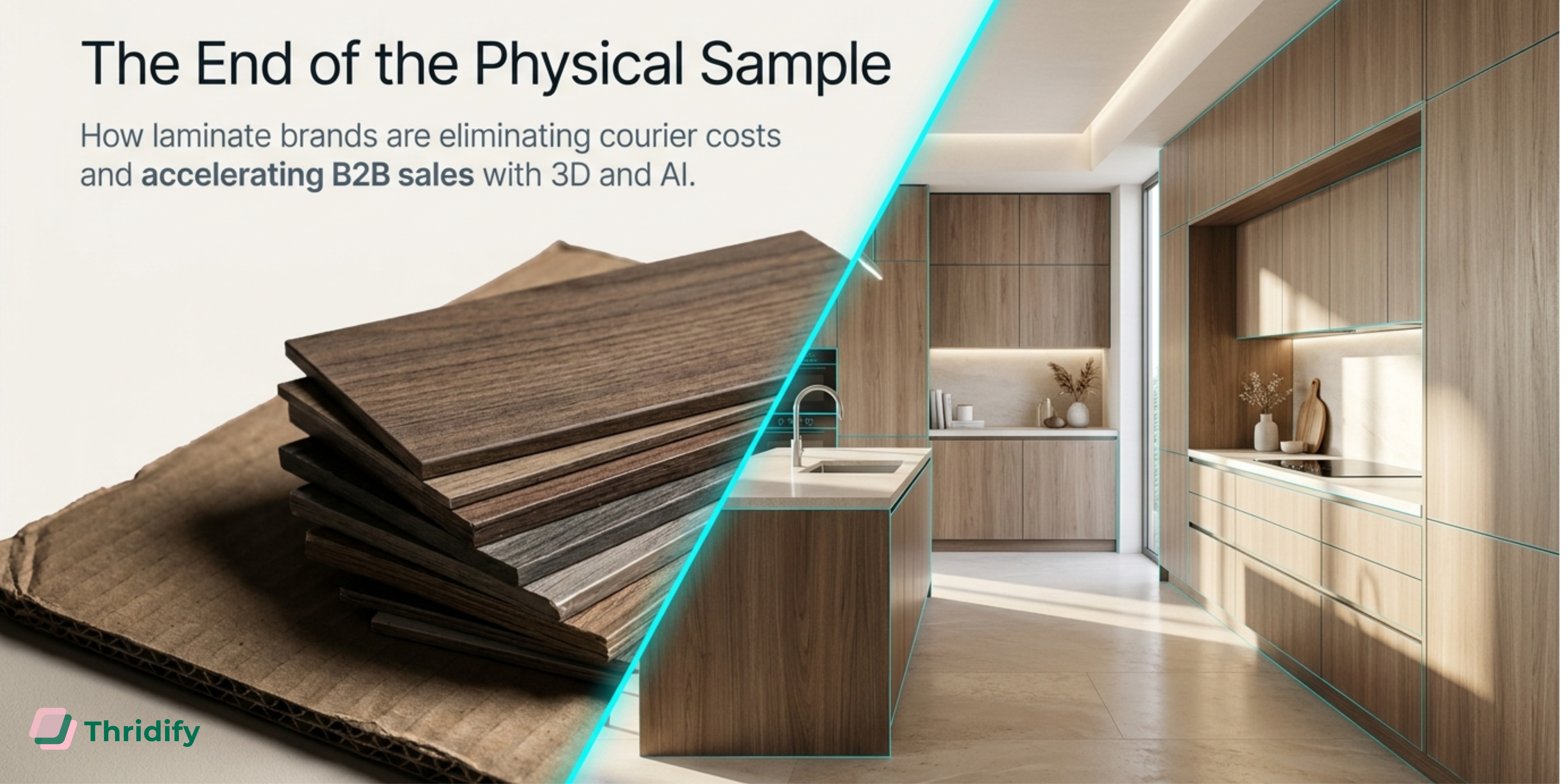

In the fast-paced world of interior design and home improvement, the wooden laminated industry—specifically those dealing in bespoke kitchens and wardrobes—is undergoing a radical transformation. For decades, the industry has relied on the “swatch book and PDF” model. However, as consumer expectations shift toward instant gratification and hyper-customisation, these traditional tools are no longer sufficient.
Today, leading brands are turning to Thridify-powered 3D enabled catalogs to bridge the gap between imagination and reality. By moving away from static imagery and embracing interactive 3D, manufacturers and dealers are discovering that the best catalogs don’t just explain a product; they demonstrate it.
The Failure of the Traditional Catalog: A Barrier to Growth
For years, dealers in the wooden laminated sector have been expected to navigate a daunting level of complexity. Managing a kitchen or wardrobe brand involves juggling hundreds of combinations of finishes, textures, hardware, and internal configurations. Despite this complexity, many dealers are still expected to sell using static PDFs and printed catalogs.
The limitations of this traditional approach are becoming impossible to ignore:
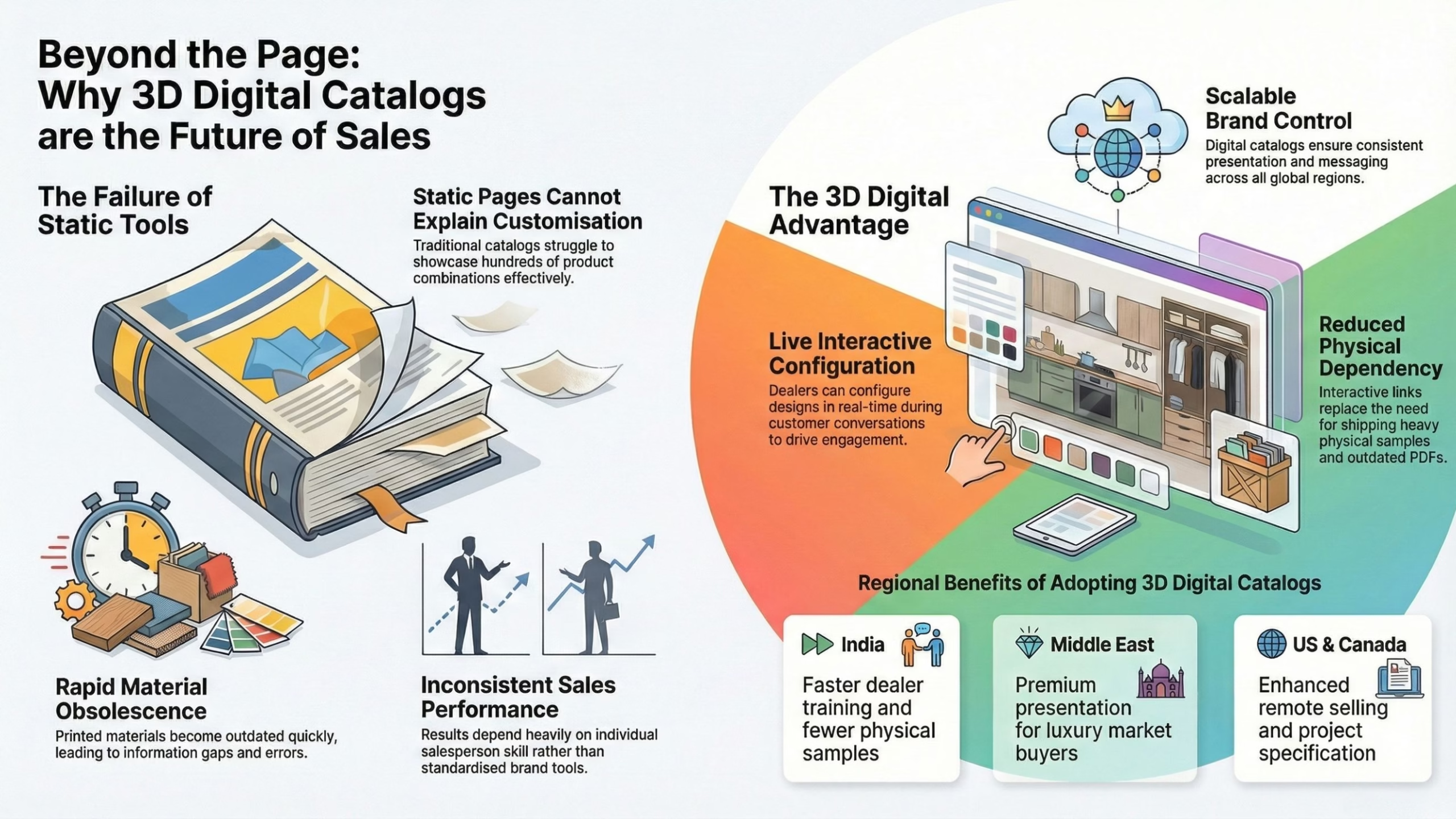
- Static Pages Cannot Capture Customisation: A printed page or a flat PDF is inherently limited. It cannot show a customer how a specific oak laminate looks when paired with a particular matte handle or how a wardrobe’s internal lighting changes the vibe of the wood grain.
- Rapid Obsolescence: In an industry where trends change seasonally, printed materials go out of date almost as soon as they are off the press. This leaves dealers using obsolete information, leading to errors in ordering and customer dissatisfaction.
- The “Skill Gap” Inconsistency: Because static tools are so limited, sales success depends heavily on the individual skill and experience of the salesperson. This creates a massive problem for brands trying to maintain a consistent experience across different regions.
The Thridify Advantage: Performance Through Interaction
Thridify-powered 3D digital catalogs solve these problems by providing precision tools for the modern dealer. Rather than asking a customer to “imagine” a finished product based on a 2×2 inch laminate sample, these catalogs enable interactive exploration.
Live Configuration: The Art of the Possible
The most significant advantage of a 3D-enabled catalog is the ability to perform live configuration during sales conversations. When a customer asks, “What if we used a darker walnut laminate instead?” the dealer doesn’t have to flip through a separate book. With a few clicks, the digital model updates instantly. This always up-to-date visual ensures that the customer is seeing exactly what they are going to buy, significantly reducing the “fear of the unknown” that often stalls high-ticket sales.
Frictionless Sharing
In the modern sales cycle, the decision-maker isn’t always in the room. Thridify-powered catalogs allow for easy sharing via links. A dealer can configure a kitchen layout with a client in the showroom and then text or email a live 3D link to the client’s partner at home. This keeps the sales momentum alive outside the physical store.
Global Impact: How Different Markets are Winning
The transition to 3D catalogs isn’t just a local trend; it is a global shift with specific benefits tailored to regional market needs.
- In India: The focus is on speed and scalability. 3D catalogs allow for faster dealer training. New staff can learn the vast product range through interactive play rather than memorising thick manuals. Furthermore, it has reduced the dependency on physical samples, which are expensive to produce, ship, and store.
- In the Middle East: The market demands luxury and premium presentation. Thridify’s high-fidelity visuals align perfectly with the expectations of luxury buyers, providing a sophisticated digital experience that matches the high-end nature of the physical laminates.
- In the US & Canada: The rise of remote selling has made 3D catalogs essential. These tools are now used for project-based specification, allowing designers and dealers to collaborate across vast distances without losing the nuances of the wood textures or cabinet configurations.
Why the Brand Wins: Control and Scalability
While the benefits to the dealer are clear, the advantages for the manufacturing brand are even more profound. For a large-scale laminate or furniture manufacturer, maintaining brand integrity is a constant struggle.
By deploying a Thridify-powered 3D catalog, brands gain better control over messaging. They can ensure that every dealer, whether in New York or New Delhi, is presenting the product in the exact same high-quality way. This leads to consistent brand presentation across the entire network.
Perhaps most importantly, it offers scalable dealer enablement. Instead of shipping thousands of new physical sample kits every time a new laminate line is launched, the brand can simply update the digital catalog. This instant update mechanism ensures that the entire global sales force is aligned with the latest offerings in real-time.
The New Mantra: Demonstrate, Don’t Explain
In the traditional sales model, the dealer spent 80% of their time explaining—explaining how the laminate would look under light, explaining how the corner unit would open, and explaining why the price changed with a different finish.
The 3D revolution flips this script. The best catalogs don’t explain; they demonstrate.
When a customer can interact with a 3D model, rotate it, change the laminates, and see the grain detail in high definition, the “explanation” becomes redundant. The product speaks for itself. This shift from verbal persuasion to visual demonstration is the key to outperforming the competition in the wooden laminated industry.
Conclusion: The Future is Three-Dimensional
The wooden laminated industry is at a crossroads. As the complexity of products grows and the patience of consumers shrinks, the old ways of selling are becoming a liability. Thridify-powered 3D enabled catalogs offer a way forward that prioritises precision, consistency, and customer engagement.
By empowering dealers with tools that allow for live configuration, interactive exploration, and instant updates, brands are doing more than just digitising a paper book. They are creating a dynamic sales environment where the product’s beauty and functionality are demonstrated in real-time, leading to higher conversion rates, fewer errors, and a truly modern brand experience.
In a world where seeing is believing, the 3D catalog is no longer an “extra”—it is the engine of the modern furniture and laminate business.